
Cleaning contract management often fails not due to lack of effort, but due to a lack of clear metrics. Without objective data, service evaluation becomes a subjective argument about whether something is “clean” or “dirty.” The professional solution is to implement an Operational Scorecard.
What is a Performance Scorecard for janitorial services?
A Performance Scorecard is a visual management tool that translates contractual expectations into measurable, objective indicators to evaluate the quality of the cleaning service.
According to research by Gajjar, Smithwick & Sullivan on Janitorial Performance Scorecards, this tool should not be used solely for punishment, but as a communication mechanism that aligns Facility Manager expectations with provider execution. A good scorecard eliminates ambiguity and enables data-driven decision-making.
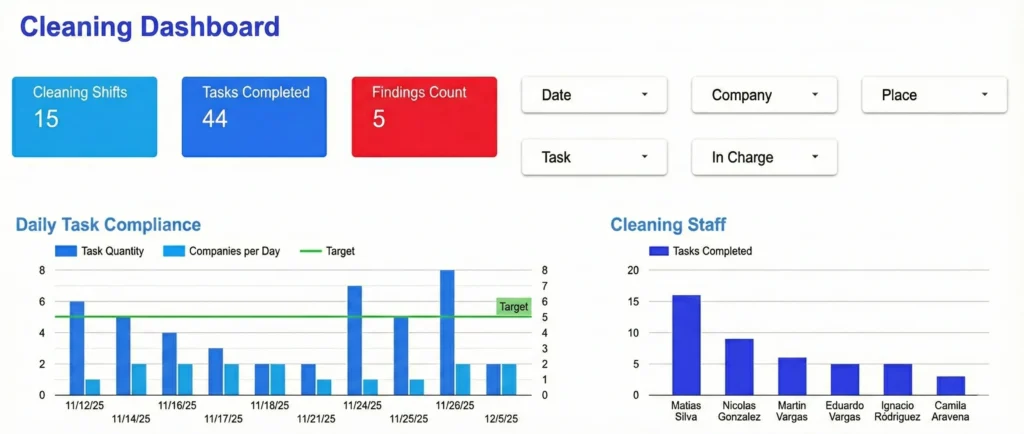
[Image Suggestion]: A digital dashboard showing compliance bars (green, yellow, red) on a tablet.
- Alt Text: DataScope dashboard showing janitorial compliance indicators.
What are the 4 pillars of a measurement system in Facility Management?
A robust system must measure four key dimensions: Technical Quality, Response Time, Compliance, and Customer Satisfaction.
Based on the performance measurement model by De Toni et al. (2007), a Facility Management contract cannot succeed by looking at visual cleanliness alone. To be effective, the scorecard must balance these four aspects:
| Dimension | Question it Answers | Example KPI in DataScope |
| Technical Quality | Does the result meet the standard? | % of areas with visual approval (with photo proof). |
| Time (Service) | Was it addressed quickly enough? | Average time to resolve incidents. |
| Compliance | Was the safety protocol followed? | % of staff with verified PPE via app. |
| Satisfaction | How does the user perceive the service? | Number of complaints per month vs. compliments. |
How does DataScope help implement this Scorecard?
DataScope transforms academic theory into operational practice by digitizing field data collection, allowing you to generate these scorecards in real-time.
Instead of using paper forms that delay information, supervisors use the mobile app to conduct quality audits. Each inspection automatically feeds a dashboard (Scorecard) that displays:
- SLA compliance instantly.
- Geo-referenced photographic evidence (proof of execution).
- Automatic alerts when an indicator drops below the acceptable threshold.
Why should metrics be shared between provider and client?
Shared metrics foster transparency and prevent contractual disputes by establishing a “single source of truth.”
The study by Gajjar et al. (2018) emphasizes that contract success lies in collaboration. When the cleaning provider and the client have access to the same dashboard on platforms like DataScope, the conversation shifts from “you didn’t clean well” to “the quality indicator in Zone B dropped 5%, let’s review the report photos to fix it today.”
Conclusion
Designing an Operational Scorecard based on academic evidence is the first step to professionalizing your janitorial contracts. However, the design is useless without an agile execution tool.
DataScope allows you to take these indicators from paper to reality, facilitating supervision and ensuring operational excellence.
Ready to digitize your cleaning audits? Try DataScope for free today and create your first automated Scorecard.